


Is Midbrain Activation Real or Just Hype Experts Honest Opinion


Every parent wants their child to learn faster, focus better, and perform at their best. It's no surprise, then, that midbrain activation has become one of the most searched topics in children's education and brain development over the last decade. But between the bold promises and the growing scepticism, where does the truth actually lie?
In this article, we take an honest, balanced look at what midbrain activation is, what the science says, what the real benefits of structured brain training are — and how you can make the smartest choice for your child's development.
What Is Midbrain Activation?
Definition (as described by training programs)
Midbrain activation is described by coaching institutes as a technique that “stimulates” or “awakens” the midbrain region of the brain.
It is claimed to help balance brain functions and unlock hidden mental abilities.
Some programs describe it as a method to go beyond normal senses and perception.
Claims made by institutes
Improved memory and concentration
Faster learning and better academic performance
Enhanced creativity and intuition
Development of “extra sensory” abilities like blindfold reading
Better emotional control and confidence
Common methods used in workshops
Blindfold activities (reading, identifying objects, or walking with eyes covered)
Memory games and visualization exercises
Breathing and meditation techniques
Rhythmic sounds or music-based focus sessions
Group activities designed to improve attention and coordination
How the Brain Actually Works (Scientific View)
The human brain is a very complicated organ that has many parts that operate together in order to perform its functions. The midbrain is a small part of the brainstem and its functions include basic processes such as controlling eye movement, reaction to sounds and reflexes; it does not contribute to functions such as improving memory capacity and perceptual skills.
In accordance with neuroscience, vision, memory and learning occur in specific organs within the brain, such as the occipital lobes, hippocampus and cerebral cortex, respectively. The learning process takes place because of the development of certain neural connections due to experiences and practice. The brain depends heavily on sensory signals from organs such as the eyes and ears to understand and interact with the surroundings. Source By: (Johns Hopkins Medicine)
Claims vs Scientific Evidence
Claimed Benefit (by programs) | Scientific Reality (what research says) |
Midbrain activation improves memory power | Memory is formed in the hippocampus and improves through practice, repetition, and learning—not by “activating” a single brain part |
Students can learn faster using midbrain techniques | Learning speed depends on attention, teaching methods, and practice; no scientific evidence supports midbrain “activation” for faster learning |
Blindfold reading or seeing without eyes is possible | Vision is processed in the occipital lobe using eyes; there is no scientific proof humans can see without visual input |
Midbrain activation enhances intuition or extra senses | Intuition is based on experience and pattern recognition, not a special activated brain region |
Training “activates” hidden brain potential | The brain already works fully; improvement comes from skill development, not unlocking unused brain parts |
What Experts and Scientists Say About Midbrain Activation?
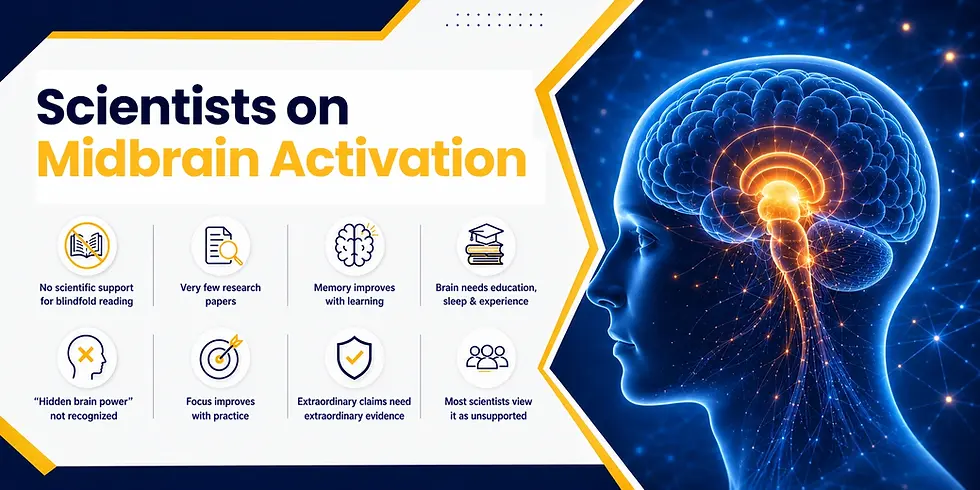
Many researchers in neuroscience and educational psychology (experts) continue to be highly doubtful of the validity of the claims made by such midbrain activation programs. From the modern perspective of brain research, there is no credible scientific basis to prove that the midbrain possesses certain capabilities that can help people develop their inner powers, such as blindfold reading.
Important Scientific Perspectives:
Scientific research does not support claims of blindfold reading
Very few peer-reviewed papers about midbrain activation exist
Memory becomes better through repetition and learning
Brain development requires education, sleep, and experience
“Hidden brain power activation” has not been recognized by neuroscientists
Focus and attention become better through cognitive exercises
Remarkable claims demand remarkable evidence
Most scientists view midbrain activation as scientifically unsupported
Why Do So Many People Believe in It?
Understanding why midbrain activation is widely accepted — despite limited scientific backing — is just as important as understanding the science. Several psychological and social factors are at play:
The promise is emotionally compelling. Parents naturally want the best for their children. A program that offers rapid improvement in memory, focus, and intelligence is highly attractive, especially when academic pressure is high.
Blindfold exercises create a powerful impression. Watching a child appear to navigate or identify objects while blindfolded genuinely seems extraordinary. This creates a strong sense that something significant is happening — even when the effect may be explained by sensory adaptation, subtle cues, or the power of focused practice.
Testimonials are persuasive. Real results — even those that come from general cognitive training, mindfulness, and structured activities — are attributed to "midbrain activation," reinforcing the belief.
Scientific literacy gaps exist. Most parents aren't neuroscientists. Without a working knowledge of how the brain actually functions, it can be difficult to critically assess bold claims, especially when they're presented with confidence and authority.
Are There Real Benefits? Yes — But the Source Matters
Here's where things get nuanced, and important.
Many children who participate in midbrain activation workshops do experience genuine improvements — in focus, confidence, memory, and learning engagement. But these benefits don't come from "activating" a brain region. They come from the underlying activities themselves:
Structured memory exercises build working memory through practice
Mindfulness and breathing techniques genuinely reduce anxiety and improve focus
Engaging group activities build confidence and social skills
Consistent cognitive challenges strengthen attention and problem-solving
Positive learning environments increase motivation and participation
The benefits are real. The mechanism behind them is not a mystical brain switch — it's well-established cognitive and educational science.
What Actually Works for Children's Brain Development
The good news is that well-supported, evidence-based approaches to brain development do exist — and they're highly effective when delivered in the right environment.
Research consistently shows that children's cognitive abilities develop meaningfully through:
Quality sleep — essential for memory consolidation and learning
Physical activity — shown to improve attention, executive function, and academic performance
Structured reading and language development — foundational to cognitive growth
Mindfulness and emotional regulation training — proven to reduce stress and improve focus
Cognitive games and challenges — strengthen working memory, reasoning, and attention
Supportive, low-pressure learning environments — enable children to engage fully
These aren't abstract theories. They're backed by decades of research from institutions including Stanford University, the National Institutes of Health, and Johns Hopkins Medicine.
So, Should You Enrol Your Child in a Midbrain Activation Programme?
That decision belongs to you as a parent — and it deserves to be made with clear information.
If a programme claims to deliver extraordinary abilities like blindfold reading or overnight academic transformation, apply healthy scepticism. The science doesn't support those specific claims.
However, if a programme uses structured cognitive activities, mindfulness training, memory exercises, and positive engagement — and it's delivered by experienced, qualified trainers — then children can genuinely benefit. Not because of "midbrain activation," but because the activities themselves are valuable.
The label matters less than the substance of what's being taught.
Train Your Child's Brain the Right Way — With School of Brain
At School of Brain, we believe that every child has remarkable potential — and that unlocking it requires the right environment, the right techniques, and the right guidance.
Our Midbrain Training Programme is built around evidence-informed cognitive exercises, structured mindfulness practices, memory training, and confidence-building activities — all delivered by our team of experienced, dedicated trainers. We don't make promises science can't back. We focus on real, measurable outcomes: better focus, stronger memory, greater confidence, and a genuine love of learning.
Based in Nagpur with online programmes available, School of Brain has helped hundreds of children and adults develop the cognitive skills that make a real difference — in the classroom and beyond.


Comments